I was flipping through old car magazines the other day, reminiscing about the golden age of American automobiles, when a thought struck me: Who would have imagined that a family-friendly wagon could pack the punch of a supercharged muscle car? It sounds like a modern fantasy, with beasts like the Dodge Challenger SRT Hellcat dominating headlines today. But let me take you back to 1957—a time when Ford, in a stroke of genius, unleashed the Country Sedan with a racing-bred supercharger. This wasn't just any wagon; it was a sleeper, blending practicality with raw power, and it all started with NASCAR's influence. As I dug deeper, I realized how this forgotten gem paved the way for today's high-performance wagons, yet it remains a rare treasure in the collector's world. Join me on this journey to uncover the story of Ford's pioneering F-Code engine and its unexpected home in the humble Country Sedan.
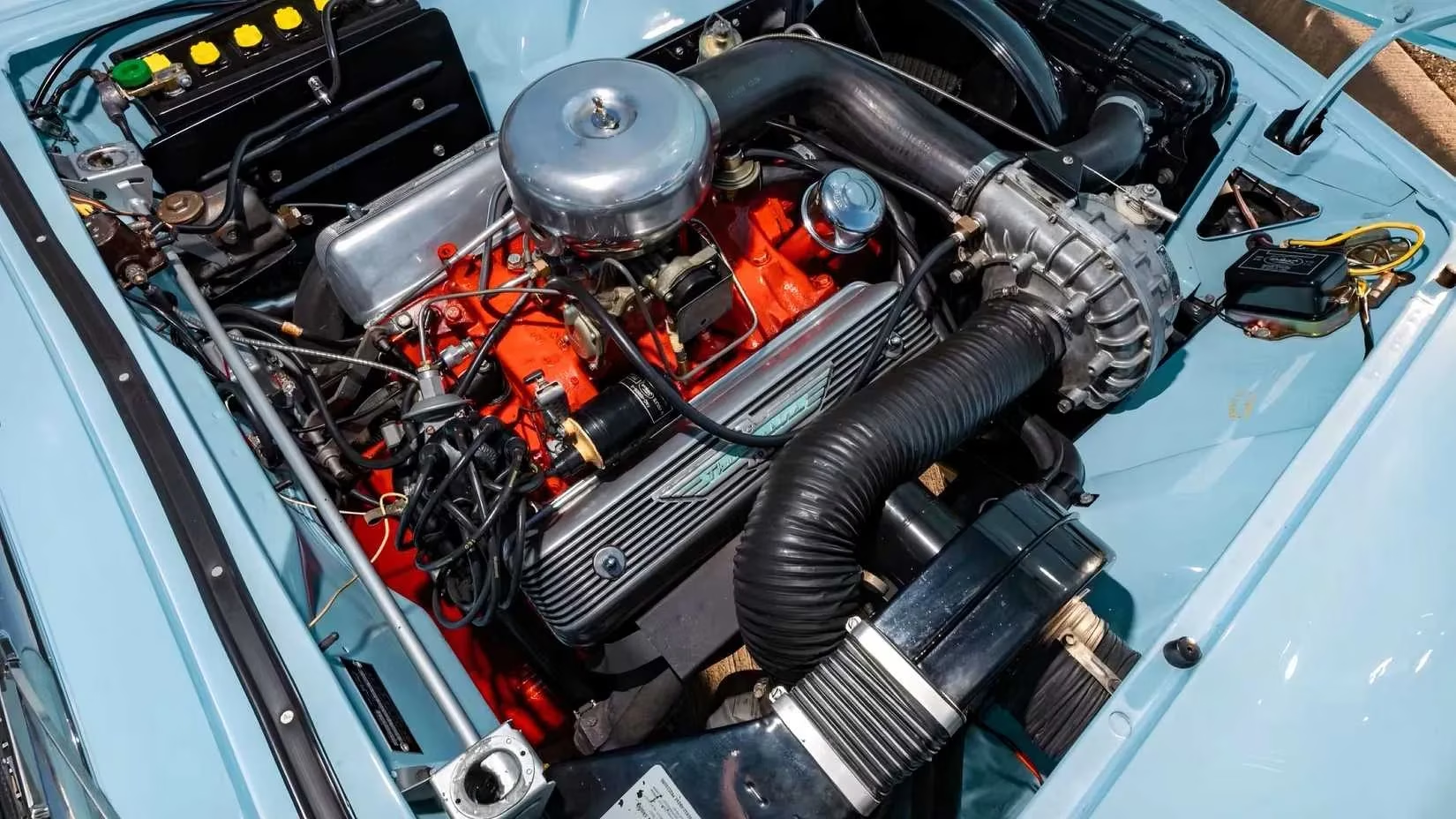
Back in the 1950s, America was riding high on a post-war economic boom, and the automotive industry was exploding with creativity. I mean, think about it—cars had fins, chrome galore, and colors that would put a rainbow to shame! 🎨 It was an era where over 58 million cars were sold, and Ford, Chevy, and others were locked in a fierce battle. The mantra "Win on Sunday, sell on Monday" drove them to innovate, translating racetrack success into showroom hits. But here's the twist: To compete in NASCAR, manufacturers had to homologate new tech by producing at least 100 road cars. Chevy went with fuel injection, but Ford? They dreamed bigger with a supercharged V8. This led to the birth of the F-Code engine, a 312-cubic-inch Y-Block V8 fitted with a McCulloch/Paxton VR57 centrifugal supercharger. Can you believe they offered this beast across their lineup, including the unassuming Country Sedan wagon? It was homologated directly for racing, giving it a true pedigree that few family cars could claim.
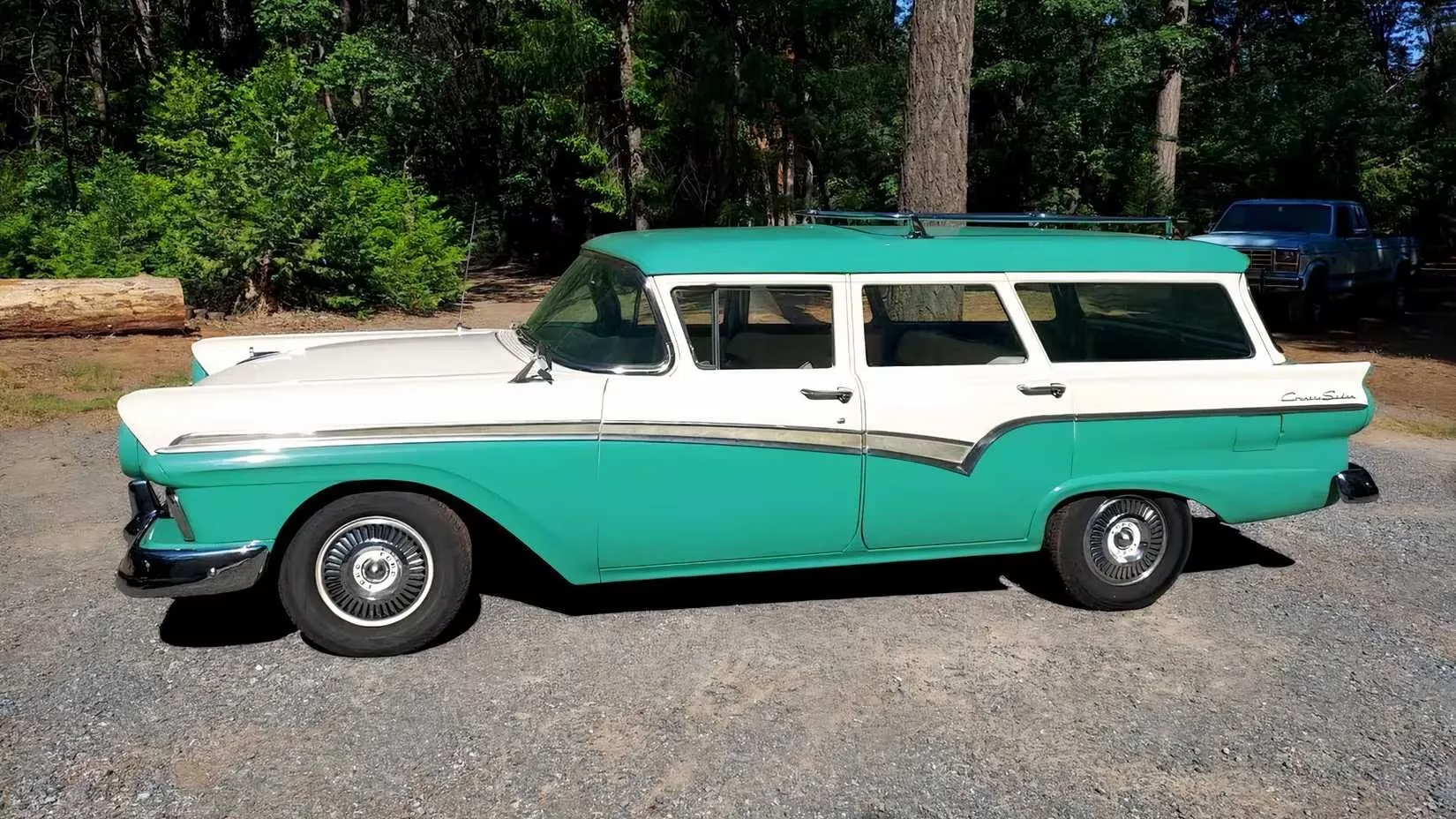
Now, let's talk specs. The F-Code engine wasn't just powerful; it was revolutionary for its time. Under the hood of that innocent-looking Country Sedan, it churned out 300 horsepower and 340 lb-ft of torque. To put that in perspective, consider the Audi RS2 Avant—often hailed as the godfather of super wagons—with its 315 horsepower from a turbocharged 2.2-liter engine. The F-Code Ford matched that punch while weighing more, and it came with transmission options: a three-speed manual or an automatic. I remember reading about a modified 1957 Ford Custom sedan hitting the quarter-mile in 13.73 seconds, proving this engine had serious potential. But why isn't this common knowledge? Well, NASCAR's rules changed fast in 1957, limiting induction to single carburetors and banning factory racing support. This cut the F-Code's racing dreams short, making it a rare footnote in history.
The rarity of these F-Code cars is mind-blowing. Picture this: fewer than 1,000 full-size Fords got the supercharger, including models like the Thunderbird and Fairlane 500 Skyliner. For the Thunderbird alone, only 200 out of 21,380 produced in 1957 had the F-Code option, and the ultra-rare Phase One version had just 15 units. But the Country Sedan? Production numbers are elusive, but estimates suggest a tiny fraction—perhaps as low as a few dozen—were ever sold. After all, who'd buy a supercharged wagon back then when flashier options existed? This scarcity makes F-Code Country Sedans unicorns today. I've scoured auctions and classifieds in 2025, and they're almost impossible to find. For comparison, here's a quick table of recent values (updated for 2025):
| Model | Condition | Estimated Price (2025) | Rarity |
|---|---|---|---|
| 1957 Ford Country Sedan F-Code | Excellent | $250,000+ | Extremely rare, few known examples |
| 1957 Ford Thunderbird F-Code | Excellent | $240,000 | Rare, with 200 produced |
| 1957 Packard Clipper Country Sedan | Good | $35,000 | Rare, 869 produced |
| Standard 1957 Country Sedan (non-supercharged) | Good | $40,000 | Common |
As you can see, F-Code models command premium prices. A Thunderbird F-Code sold for $224,000 in 2023, and by 2025, values have climbed due to inflation and collector demand. For buyers, the key is checking the VIN for an 'F' prefix—it's the only way to confirm authenticity. But what about alternatives? If you're craving a '50s super wagon, the Packard Clipper Country Sedan is another option. It used a supercharged 289-ci V8 with 275 horsepower, and about 869 were made. I saw one sell for $60,500 in 2011, but today, Hagerty values it around $35,000 in good condition. Still, finding either is a challenge—they're relics of an era when innovation met everyday practicality.

Driving one of these today would be a dream. Imagine cruising in that Country Sedan with its retro charm—chrome accents, spacious interior, and that hidden supercharger whine. 🚗💨 It's a true sleeper, looking like a harmless jukebox on wheels but ready to roar. Reflecting on this, I can't help but wonder: Why did such a groundbreaking model fade into obscurity? Perhaps it was bad timing with NASCAR's rule changes, or maybe buyers just weren't ready for a high-performance wagon. But its legacy lives on in modern icons like the Volvo T-5R and Audi RS2. For collectors in 2025, snagging an F-Code Country Sedan is like finding buried treasure—a piece of history that redefined what a family car could be. So next time you see a wagon, remember Ford's bold experiment from 1957. It wasn't just a car; it was a statement that power and practicality could coexist, long before it became cool.