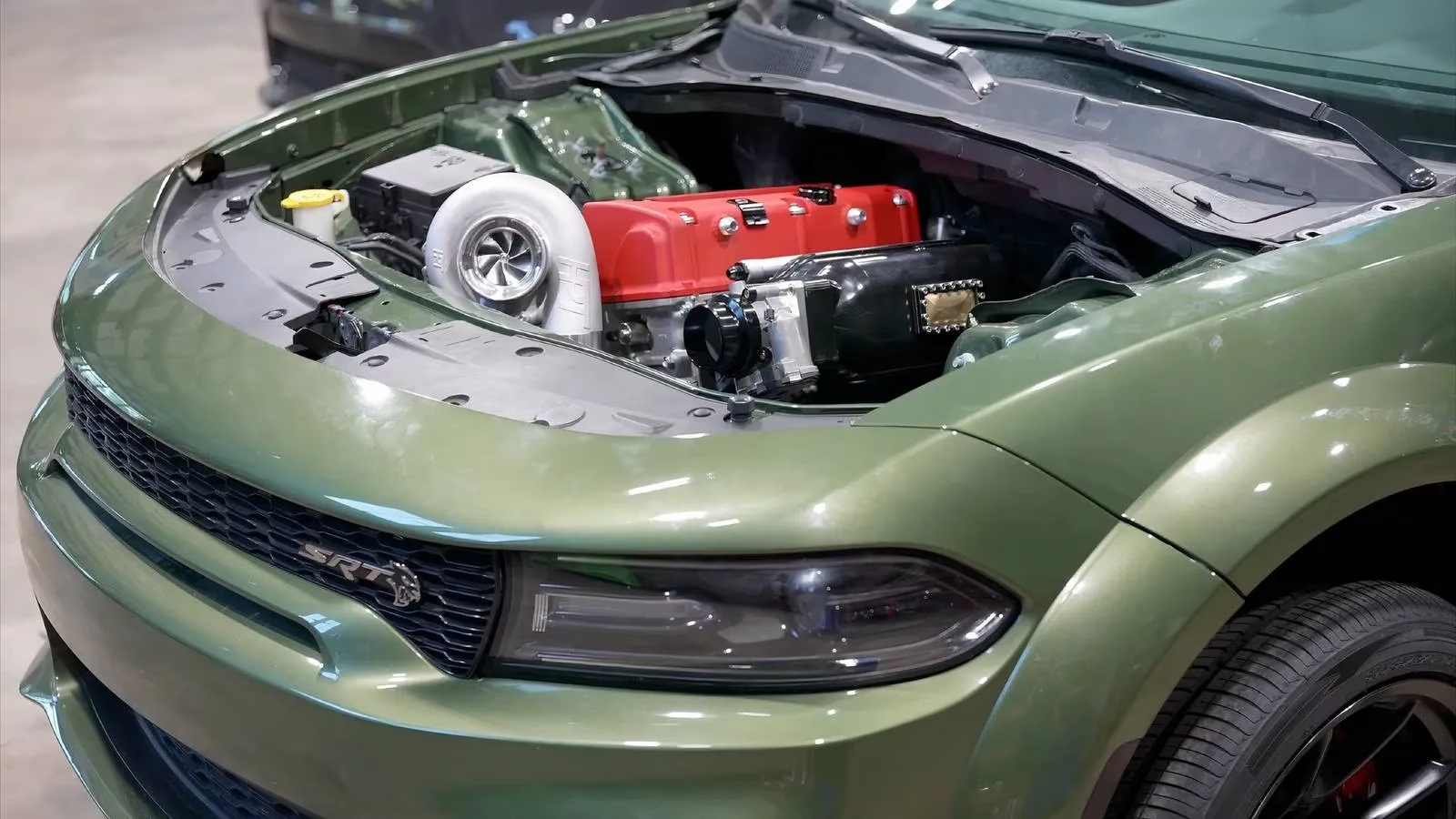
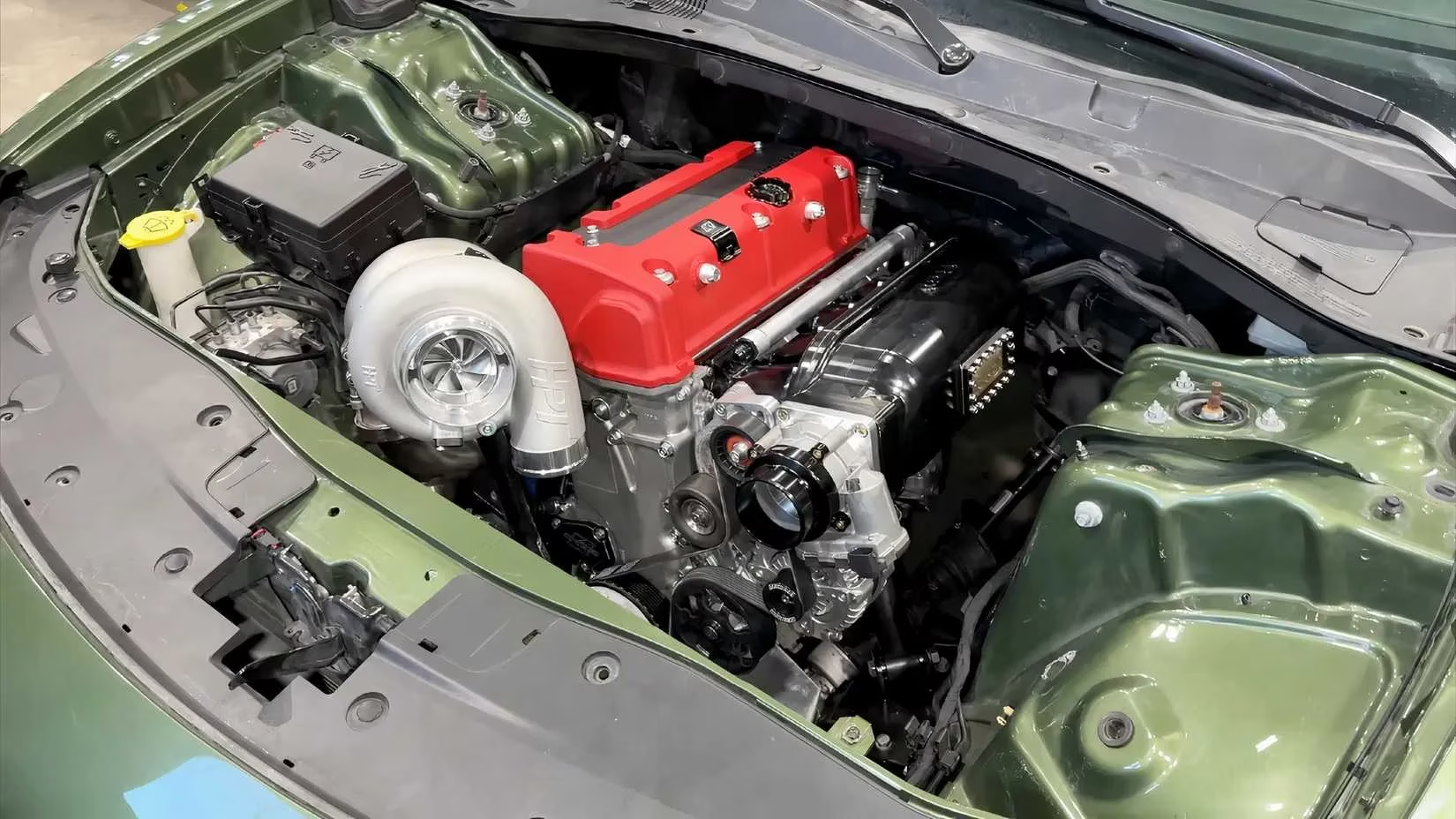
For decades, engine swaps have followed a familiar script: take a big engine, stuff it into a smaller car, and let chaos do the rest. ScrapLifeLee’s project flips that script in the loudest way possible. The starting point is a 2021 Dodge Charger Hellcat Redeye, a 797-hp Mopar heavyweight with a supercharged V8 heart. Instead of tuning that already monstrous HEMI, the team pulled it out and installed a Honda K24 four-cylinder. On paper, it sounds like a joke. In practice, it is a turbocharged experiment with four-digit horsepower potential.
Why Remove a 797-HP HEMI?
That is the first question any Mopar fan will ask. The Hellcat Redeye’s supercharged V8 is a legend, and yanking it out of a Charger sounds like sacrilege. But the K24 has a different kind of reputation. It is the engine many enthusiasts know from Accords and CR-Vs, yet it has become a favorite for forced induction because it can handle serious boost with the right internals.
With a 68-millimeter turbo, upgraded fueling, and a free-flowing intake, the K24 can push toward 1,000 horsepower. That changes the conversation completely. A four-cylinder Hellcat is not a downgrade in the abstract; it is a different kind of build, one that trades displacement for turbocharged violence. The goal is not to copy the Hellcat formula. The goal is to break it and see what happens.
| Category | Hellcat HEMI V8 | Honda K24 Swap |
|---|---|---|
| Cylinders | 8 | 4 |
| Forced induction | Supercharged | Turbocharged |
| Power potential | 797 hp stock | Up to four-digit power with built internals |
| Weight on nose | Heavy iron block | Roughly 340 pounds lighter |
| Personality | Straight-line bruiser | High-boost experiment |
Fitment Was the Real Boss Fight
Dropping a smaller engine into a bigger bay sounds easy. It was not. The K24 is physically smaller than the HEMI, but the Charger’s engine bay was never designed for it. The oil pan clashed with the steering rack, clearance under the cowl was tight, and the K24’s tilted design made alignment tricky. This was not a simple swap. It was fabrication, cutting, welding, and hoping everything cleared.
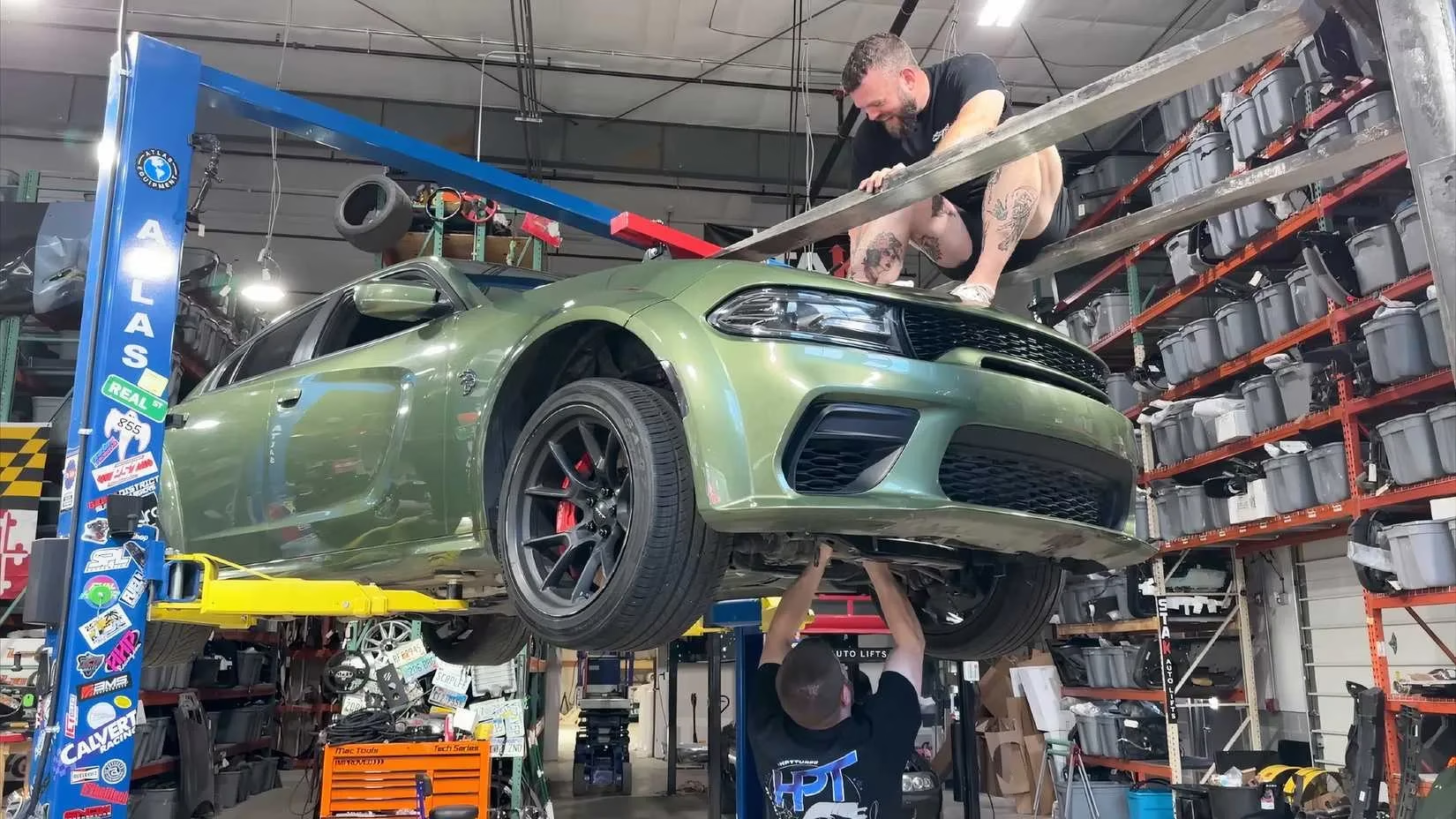
That kind of work is where engine swaps become interesting. The internet loves the idea of a clean drop-in, but real builds are full of small problems. Mounts need adapting. Pans need modifying. Clearances need checking again and again. The team had to solve fitment issues one by one, and the result is a setup that looks bizarre but works.
Keeping the Hellcat’s ZF 8HP90 Transmission
One of the smartest parts of this build is that the team retained the factory Hellcat transmission. The ZF-sourced 8HP90 automatic is a beast in its own right, known for fast shifts and the ability to swallow huge amounts of torque. Pairing it with a turbo Honda four-banger meant adapting mounts, modifying pans, and working through fitment problems, but keeping the Hellcat gearbox gives the project a familiar backbone.
That transmission choice also says something about the build’s intent. This is not a delicate economy-car swap. It is a Hellcat chassis with a turbo four-cylinder, and the driveline still has to handle serious power. The 8HP90 gives the project a fighting chance to put that power down, whether it ends up on a dyno, a drag strip, or a very surprised stretch of highway.
Weight, Balance, and the Street-Fight Question
The weight savings are massive. Pulling the Hellcat’s iron block cut roughly 340 pounds off the nose. For a car that has always been more of a straight-line bruiser than a corner carver, that is a big deal. Less mass up front can improve turn-in, sharpen the steering, and make the Charger feel less like a missile and more like a machine with some agility.
Will it out-corner a proper sports car? Probably not. The Charger is still a big sedan, and this build is still a work in progress. But the potential is fascinating. If the K24 can make just as much power as the old V8, or more, while weighing less, the swap could deliver a car that is not only fast but also sharper than any Hellcat has a right to be.
The Debate Is Half the Fun
This build is already stirring up debate. Mopar fans may call it sacrilege. Honda fans see it as vindication. Some people will hate the idea of removing a 797-hp V8, and others will love the audacity of replacing it with a turbo four-cylinder. Either way, the project breaks every rule in the book, and that is exactly why it is worth watching.
As of 2026, the build is still a work in progress, but the concept is clear. It is an engine swap built on experimentation, fabrication, and boost. The Hellcat name brings expectations of brute force, while the K24 brings a different kind of potential. Put them together, and the result is a Charger that no one saw coming. 🚗💨