You know, for a brand that's been gone for over 15 years now, Pontiac still has a grip on the muscle car world like few others. It's 2025, and the legends live on, not just in museums, but in garages and on tracks where enthusiasts like me keep the spirit alive. The story of Pontiac is one of clever engineering and pure passion, born from a twist of fate. When General Motors clamped down on factory racing back in the day, Pontiac didn't just give up. They pivoted, pouring all that performance know-how into the street-legal pony and muscle cars we revere today. Think about it: the GTO, the Firebird, and of course, the king of the hill—the Pontiac Trans Am. Those cars weren't just fast; they were statements. They were powerful, relatively affordable, and had a style that screamed rebellion. Under those long hoods, you'd find the heart of the beast: rumbling V8 engines that promised and delivered pure, unadulterated joy.
I recently got lost down a rabbit hole watching an incredible build video from FuelTech USA. It felt like a sign, a nod from the universe that the old racing ban is truly a thing of the past. The star of the show? A snarling, yellow-green metallic 4th generation Pontiac Trans Am, undergoing a transformation from classic cruiser to an ultra street racing monster. This wasn't just a tune-up; this was a full-blown metamorphosis.
Let's talk about what made the 4th-gen Trans Am, especially the WS6 package, so special back in its prime. It was the full '90s experience: those iconic T-Top roofs you could pop out for an open-air drive, and the mischievous pop-up headlights that gave it such a distinctive face. But the real magic was under the hood. You were looking at either a beastly 5.7-liter LT4 V8 or the legendary 5.7-liter LS1 V8. We're talking about 305 to 325 horsepower and 335 to 350 lb-ft of torque straight from the factory—serious numbers for the time that promised thrilling drives.
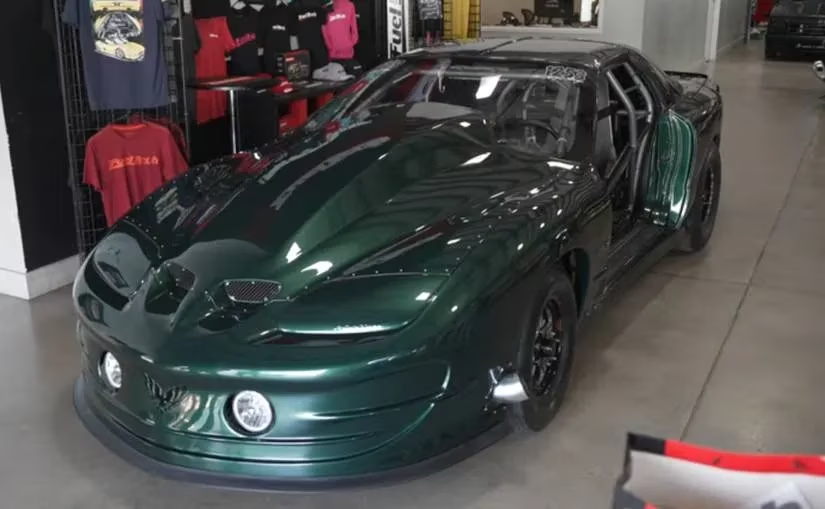
But the car in the FuelTech video? That was a different animal entirely. It started life as a 4th-gen, sure, but its soul had been completely rewritten. The original engine was long gone, replaced by a monstrous 342 cubic inch LSX block. This thing was built for war: short stroke, large bores, designed to scream to high RPMs, and all force-fed by a turbocharger. The owner, Jerry Guy, had one clear goal: make it "ultra street racing ready." And to tame this mechanical dragon, they called in the experts. The entire operation—fuel, spark, air, everything—was managed by a suite of FuelTech wizardry: the FT500 EFI system, massive FT injectors flowing 520 lb/hr, and the precise WB-O2 Nano sensors.
The moment of truth on the dyno was nothing short of cinematic. The first fire-up wasn't a gentle purr; it was a declaration. The numbers flashed on the screen: 1,065.9 horsepower. My jaw dropped. That's a jump from ~325 to over a thousand! But they weren't done. After some more meticulous tuning, the power climbed even higher. 1,179.8 horsepower. Absolutely insane. But the story didn't end there. Despite hitting some snags—rocker arm issues that forced a pause—this Trans Am warrior fought through and laid down a final, earth-shattering number: 1,301.1 horsepower. Let that sink in. From a car you could once buy at a dealership.
Now, you might be wondering, what exactly is "ultra street racing"? It's not just illegal street meets (though the spirit is there). It's a legitimate, organized drag racing class that's incredibly popular right now. It's the perfect arena for American muscle like this Trans Am. The rules are designed for intense, heads-up competition on relatively small tires, which puts a huge premium on driver skill and traction. You can modify heavily—swap in different engines, turbocharge or supercharge—but there are strict limits (like allowing only one major power-adder) to keep things competitive. It's all about building the fastest, most brutal street-legal machine you can, and then proving it over an intense 1/8th mile sprint.

Watching this build solidified something for me. The Trans Am, much like the GTO, was always Pontiac's brilliant answer to corporate restrictions. It wasn't just a car; it was a loophole with a V8. And that legacy makes it the perfect foundation for a modern race build. The chassis is strong, the proportions are right, and it's just waiting for more power. There's a racing DNA baked into its very frame that translates perfectly to today's street and strip scene.
And here's the practical side that speaks to me as a builder in 2025: value. According to the latest data, a clean, fourth-generation Trans Am will set you back around $25,000 on average. Compare that to a similar-year Chevrolet Corvette, which averages closer to $35,000. That's a significant difference! For someone like me who's going to rip out the interior, cage it, and swap the drivetrain anyway, starting with the Pontiac is a no-brainer. It frees up budget for the good stuff—the engine, the turbo, the FuelTech system—without starting from a six-figure platform.
So, what's the takeaway from this insane 1,300-horsepower journey? It's that the spirit of Pontiac is far from dead. It's alive in garages where wrenches turn, turbos spool, and dynos light up with numbers those original engineers could only dream of. Building a car like this Trans Am isn't just about speed; it's about connecting with history, solving puzzles, and creating something utterly unique. It's proof that with the right vision and modern technology, these classic icons can not only compete with but absolutely dominate the modern performance world. Now, if you'll excuse me, I think I need to go browse some classifieds for a 4th-gen project car. The bug has definitely bitten.
🚗 Key Takeaways from the Ultimate Trans Am Build:
-
The Heart: 342 LSX engine with turbo setup, replacing the original 5.7L V8.
-
The Brain: FuelTech FT500 EFI system managing the entire operation.
-
The Result: A staggering 1,301.1 horsepower on the dyno.
-
The Mission: Built to compete in the "Ultra Street" drag racing class.
-
The Appeal: Classic Pontiac style with a robust chassis, combined with modern tuning potential and relative affordability compared to other platforms.